
2_MIN_READAI Video Production
AI vs Traditional Video Production: What Brands Need to Know
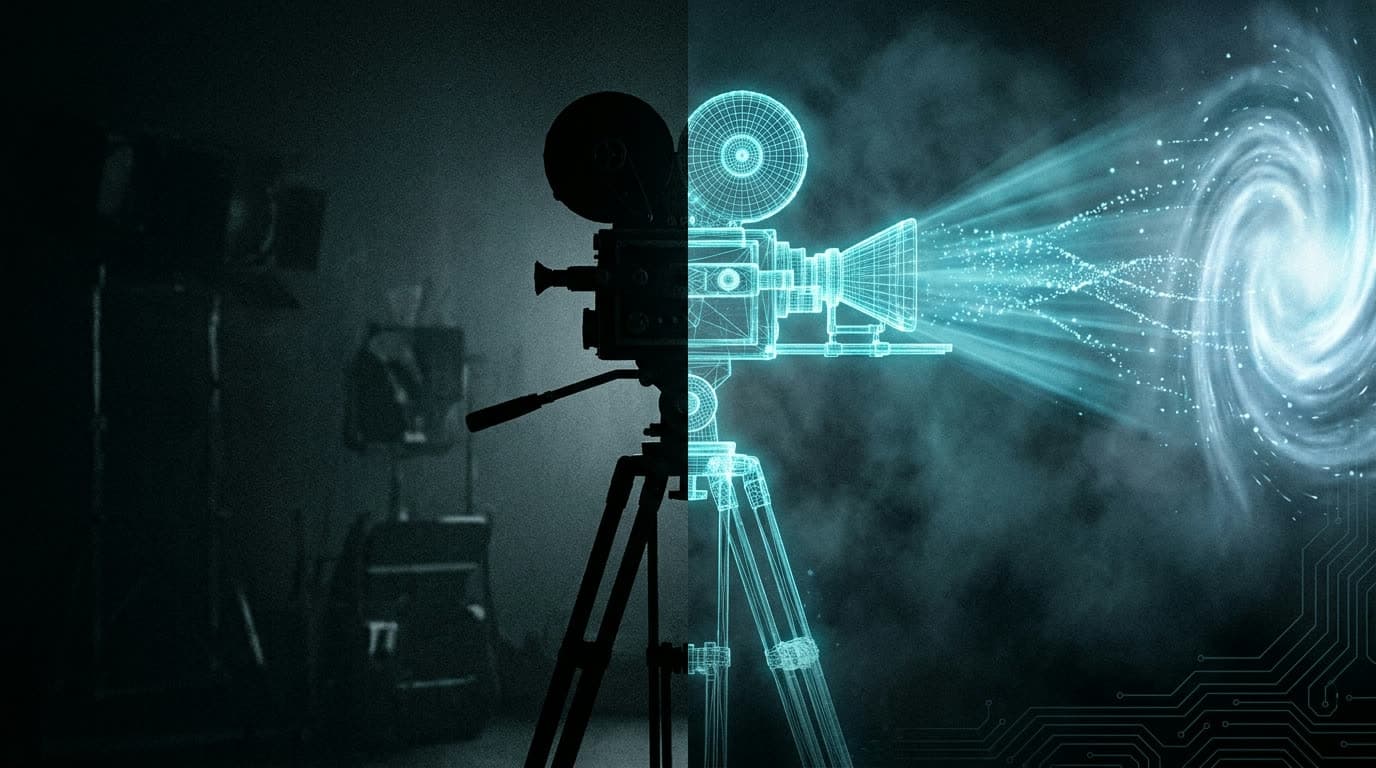
Speed, cost, creative range, and the honest limitations — a working director's comparison of AI and traditional video production for brand work in 2026.
Every brand asking about AI video eventually asks the same question: is it actually as good? The honest answer is that it's not the same craft with a discount — it's a different production model with different strengths. Here's the comparison we walk clients through, without the hype in either direction.
Where AI production wins outright
Speed
A traditional brand film runs 8–12 weeks from brief to delivery: pre-production, location scouting, shoot days, editorial, grade. An AI production collapses the middle: there is no shoot to schedule, no weather to wait on, no location permits. Typical NFX timelines run 1–3 weeks for the same runtime.
Cost structure
No crew, no sets, no travel, no casting. You pay for direction, design, generation cycles, and editorial. The full breakdown is in our AI video production cost guide, but the headline: scenes that are impossibly expensive to shoot are merely normal to generate.
Creative ceiling
This is the underrated one. A spacecraft tour through five branded worlds — like our WonderVerse film for Elephant House — has no traditional budget. Not "expensive": nonexistent for an FMCG brand. AI removes the physics from the brief. Historical recreations, impossible camera moves, worlds that don't exist — they all cost roughly the same as a kitchen scene.
Iteration
Changing a finished scene in traditional production is a reshoot — new crew call, new budget line. In AI production it's a regeneration cycle. Campaigns can adapt mid-flight.
Where traditional still wins
Live events and real people. Press coverage, founder interviews, event aftermovies built from real crowd footage — if the value is the reality of the moment, shoot it. (We produce event films too, and we'll tell you when a camera is the right tool.)
Brand archives. If you need footage of your actual factory, your actual team, your actual product texture under studio light — shoot it once, properly. AI can then extend that material further than you'd expect.
Regulatory contexts. Some industries require demonstrable, unaltered footage. Know your compliance rules before choosing any production model.
The hybrid truth
The real 2026 answer is that the best work mixes both: shot footage where reality matters, AI generation where imagination matters, one edit, one grade, one story. Our Deep Jungle Festival teaser previsualized an entire main stage before it was built — then the real event inherited a visual identity the audience already recognized.
Quality is a direction problem, not a tool problem
Bad AI video looks like bad AI video for the same reason bad shoots look bad: nobody directed it. Prompting a model is not production. Scripts, shot lists, look development, character locks, edit rhythm, sound design — the craft didn't disappear, it moved. That's why our pipeline is 100% AI-powered and 100% human-directed.
The decision framework
Ask three questions:
- Does reality itself carry the value? → Shoot it.
- Does imagination carry the value? → Generate it.
- Both? → Hybrid, one director.
If you're weighing a specific project, tell us the brief — we'll tell you honestly which model fits, including when the answer is a camera crew.
Join the conversation
Ask a question, share an idea, or leave a little appreciation.
Loading discussion…
// MORE_TRANSMISSIONS
How to Keep the Same Character Across AI Images and Videos
Faces that change from shot to shot are the biggest giveaway of AI content. Here is a practical workflow for consistent AI characters — from reference photos to finished video.
READ_TRANSMISSION
How to Write AI Video Prompts That Look Cinematic: Camera, Lens and Light
Generic prompts make generic videos. Learn the film language — shot size, camera movement, lens, lighting and colour — that turns AI clips into cinematic shots.
READ_TRANSMISSION
Kling vs Seedance vs Wan vs Hailuo: Which AI Video Model Should You Use?
A practical guide to choosing between today's leading AI video models — what each one is good at, and how to test them side by side without paying for four subscriptions.
READ_TRANSMISSION